
Landbanks with Yield
Why Valuing Landbanks With Yield Can Be Difficult (Using a Christchurch Yard Site as an Example)
6/1/20267 min read
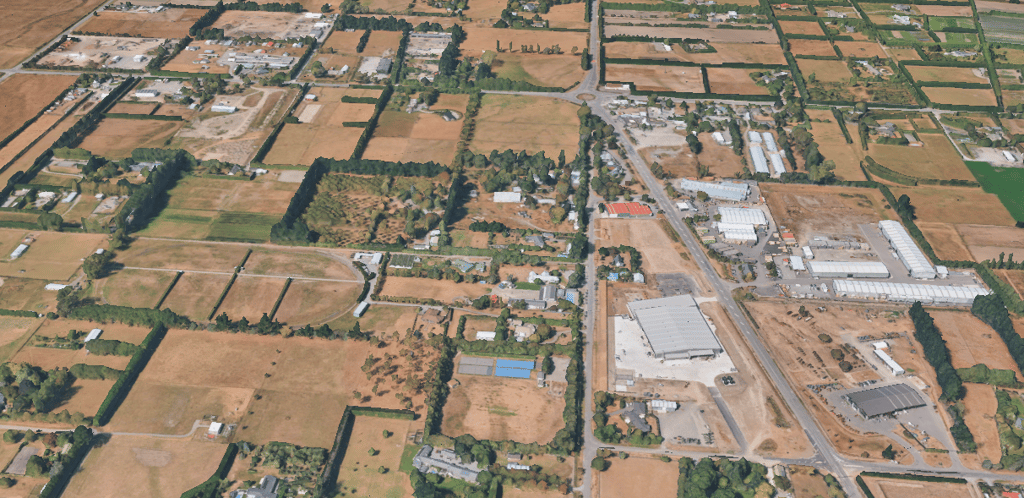
Christchurch site. 4Ha rural-urban fringe zoned landbank with 214k holding income from various yard leases and pitched at a 4.6% cap rate
Valuing land on the edge of a growing city sounds like it should be straightforward: apply a land rate, capitalise the income, add some upside for future development, and you’re done. But in reality fringe land and landbanks with income like large yard/storage properties/greenhousing refuse to behave that neatly. The issue is that these assets are not a single investment type. They are three overlapping ones, each with different assumptions, risks, and valuation methods. That mismatch is where most of the pricing variation comes from and why proper due diligence on these sites is crucial to not misprice the value.
You aren’t valuing one asset, you are valuing three
Like our Christchurch example, a multi hectare site on the urban fringe with income typically contains:
1) A landbank component
This is the “floor value” what the land would be worth without any income, assuming its current zoning and highest realistic rural use.
2) An income-producing component
In this case, yard leases generating around $214,000 per year. This looks like a standard commercial investment at first glance.
3) An option value component
The possibility that the land can be intensified, subdivided, rezoned, or converted into a higher-value industrial or logistics asset over time.
Each of these is real value but none of them fully reflects the asset on its own.
The land value anchor (the floor)
Most buyers still start with land value. In fringe Christchurch contexts, you might see implied land values in the broad range of ~$40–$80/m² depending on zoning, access, and servicing.
That creates a baseline, often around the $1.5–3 million range for a site of this scale, with some adjustment based on specific site characteristics. This is the safest, most tangible part of the valuation and it assumes the following:
no special development
no income premium
no speculative uplift
But it also ignores the entire reason these sites are attractive in the first place. Looking at the site from this lens alone will probably not attract the interest of the vendor who sees more value.
The income illusion: why $214k/year is harder to value than it looks
At face value, $214k/year looks like a straightforward commercial yield asset.
If you apply cap rates:
4.6% → ~$4.6M value (what this site was marketed as)
5.5% → ~$3.9M value
6.5% → ~$3.3M value
7.5% → ~$2.8M value
So immediately, the “income value” alone spans a wide range. But here’s the key issue: yard income on rural fringe land is rarely equivalent to institutional-grade commercial property.
Why?
Tenants are often small operators with shorter leases
Uses are flexible and sometimes transitional
Income can change significantly if the site is redeveloped
Income can change significantly as leases expire
Zoning may not support permanence of use
Lease structure is often fragmented
So most commercial buyers do not fully capitalise this income at low (prime) cap rates. They capitalise it as a higher risk asset (high cap rate). Any bonus redevelopment potential is then quantified and added to the price if that is the intention.
And landbankers? They treat it as carry income - something that helps fund holding costs while waiting for a bigger outcome.
For landbankers, this is a critical mental shift:
The income is not the asset. It is the subsidy for holding the asset. If purchasing as a landbank for future upside, ask yourself “what present value do I place on a 214k pa income stream?”. That will then warrant your next question “how long do I expect to hold this site for? What is the duration of my exit strategy?” If I look to exit the deal on a ten-year rezone timeframe, this income stream would have a value significantly greater value than holding the site for three years. This is contrary to the mindset of a commercial investor typically looking to hold strong cashflow assets in perpetuity.
The hidden third asset: unused land and latent yield
In many of these sites, a significant portion of the land is underutilised. In this case, roughly 16,000 m² of the site is unused bare land that could potentially be converted into additional yard space. On paper, that looks like pure upside and if fully activated at typical yard rates:
$10–$30/m²/year could generate $160k–$480k additional income, dependent on the setup (paved with security vs say a limited development with compacted hardstand only).
That would radically change the economics of the site. But this is where valuation becomes uncertain. To realise that income you’d need:
Likely $1m–$2m in earthworks and infrastructure.
Strip topsoil to waste, replace with compacted metal (high variation here, depending on existing ground conditions)
Stormwater and drainage upgrades (lease holders will quickly leave if water ponds or potholes form across the site)
Possible utilities upgrades (improved power and lighting)
Possible access and traffic engineering changes (lease holders will find other sites if truck movement and access is restricted)
Fencing, security, and operational setup (adds premium)
Consent or use compliance clarity (de-risks income, prevents Council or neighbour risks)
Tenant demand at scale (verified local demand, typically contractors looking for equipment/yard/container storage)
Now we’re thinking like a Developer considering a build to rent project. That would trigger a fully priced project feasibility and discounted cash flow model. The question to answer: “what is the net present value of the development angle”
Why simple cap rates break down here
Commercial cap rates assume:
stable income
long-term tenancy
predictable risk
no structural change to the asset
Fringe yard land usually has none of those guarantees. Instead, it behaves more like a transitional asset between rural land and industrial development which means:
income is real but not permanent
land value is real but not fully realised
upside exists but is probabilistic
So applying a single cap rate to the entire property is difficult.
How sophisticated buyers actually think
Most experienced investors mentally split the asset into the following:
Step 1: Landbank anchor
“What would I pay for the land if the income disappeared tomorrow?”
Step 2: Income carry value
“How much does the existing cashflow reduce my holding cost and risk?”
Step 3: Option value
“What is the probability-weighted upside of intensification or better utilisation?”
Importantly, these are not simply added together. Instead, they are blended with heavy overlap adjustments:
income is partially capitalised
land value is adjustd for optionality
upside is discounted for timing and uncertainty
Why buyers can arrive at very different prices
This is why fringe land sales often produce wide valuation spreads.
One buyer sees a 4.6% yield investment, stable $214k income and an immediate valuation around $4.6m+. While another sees uncertain yard income, rural zoning constraints, CAPEX required to unlock expansion and a valuation perhaps closer to $2.5–$3.3m. The council values at $1.85M with the land component at $1.26M. So who is right and who is wrong and what future are they pricing?
The risks when assessing income producing landbanks
Hybrid, income producing landbanks such as this are difficult to value because they sit in a grey zone between three asset classes:
Commercial, income producing property
Raw land investment
Development option
Each lens produces a different valuation, and none of them fully captures the whole picture on its own. The result is that pricing becomes less about precision, and more about judgement:
How permanent is the income?
How real is the development pathway?
How much capital is required to unlock upside?
How much time might be required for up zoning to materialise
What is the exit strategy and holding timeframe?
In assets like these, valuation is not a number but it is a probability weighted thesis about what the land might become over time.
Who is this site for?
Our analysis of the site:
Primarily it’s a landbank. It sits in strategic location in proximity to the airport precinct. Surrounding use of nearby parcels are already acting as quasi-industrial land. The zoning (Rural Urban Fringe) is often viewed as a strategic holding zone for potential future urban growth, but there is no guarantee that a specific property will eventually be rezoned. The greatest upside would likely be pressure for expansion of airport land which is already within close proximity.
There is no 3 waters infrastructure in this area but the site is reasonably well positioned to eventually capture trunk line infrastructure through a neighbouring site.
We believe the site has a moderate chance of upzoning to industrial related usage within 20 years, but not full capture of value within this zone due to site geometry and access characteristics and possible servicing limitations. The site will likely continue to capture value through transitional industrial usages as is currently the case, but unless amalgamated with other neighbouring sites, is unlikely to develop into a candidate for prime industrial. It is a landbank with rezoning upside but not the strongest candidate in the area for a revaluation multiple.
The site can be best considered as a defensive landbank. It has upside potential through rezone or additional development of the underutilised component of the site as yard space. With the holding income, the site has downside protection and the ability to offset holding costs
The site is best suited to long term investors looking to minimise downside risk but seek exposure to the upside potential which will likely materialise over a 20-30 year timeframe. Over this timeframe, holding income and inflation will eat away any debt while escalation of land values is likely to average 5 or 6% without rezone. If rezone and/or nearby development occurs, the site is likely to experience a multiplier event in addition to land escalation.
For developers or shorter timeframe investing, the site has optionality to develop the yardspace and increase holding income to fully utilise the site. There may be a rental reversion strategy to deploy here if leases and rent can be stabilised post development.
For commercial businesses, there may be interest to utilise the site for their own use, while retaining the upside of a growth area.
So is it worth the $4.6M asking price?
Verdict – For long term investors, landbankers, or commercial investors looking at rent reversion strategies there could be a case to purchase with a 4 at the front. For developers, this number would likely be less and they would be competing with other similar, cheaper nearby sites where they may attempt to create the same income from scratch, without paying the premium.